How the NRL finals series works
Eight teams, four weeks, two out each week until the Grand Final. How the NRL finals bracket works and what each ladder spot is worth.
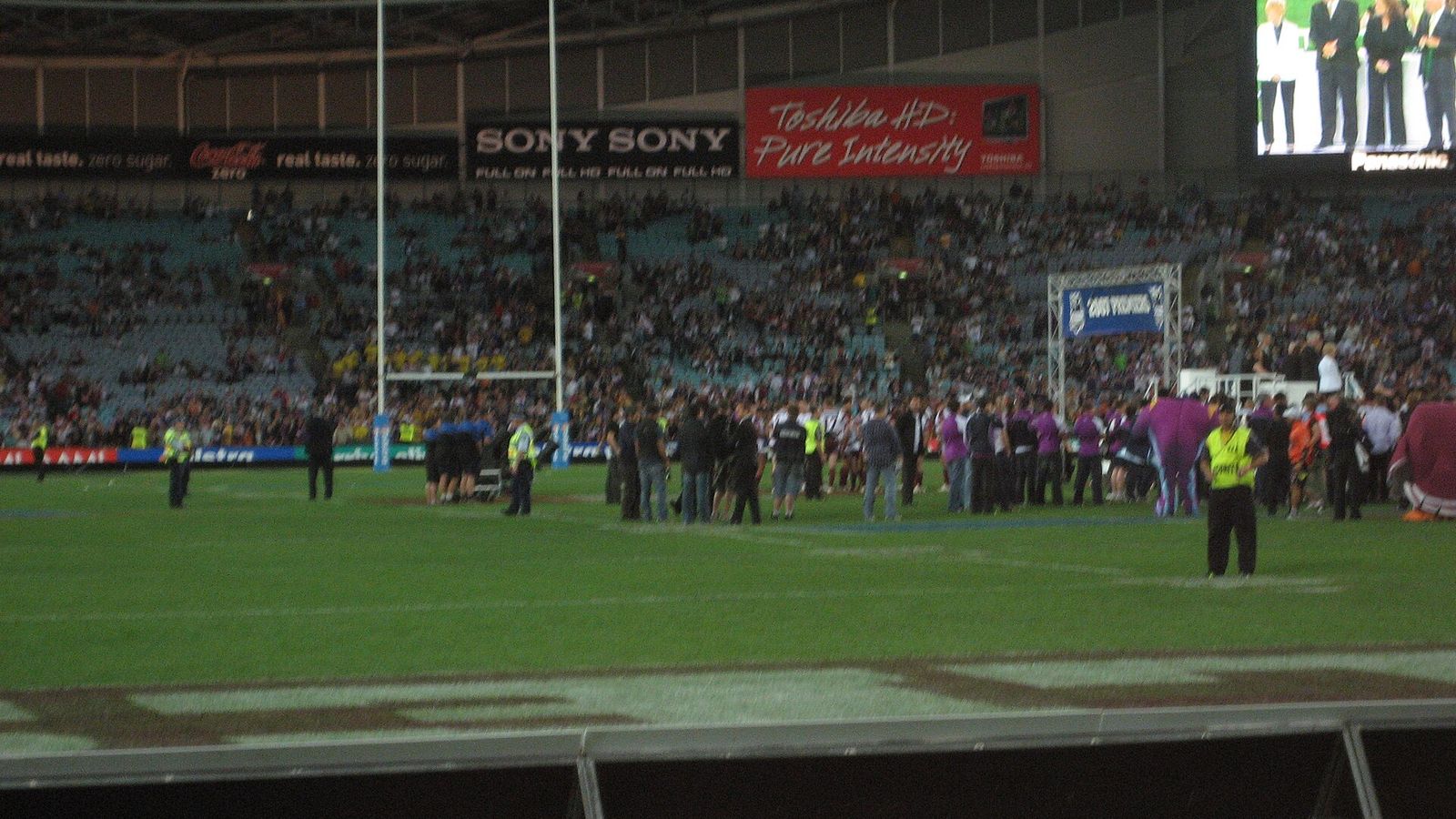
The NRL premiership is decided by a four-week finals series between the top eight clubs on the ladder at the end of the regular season. Two teams go out in each of the first three weeks, and the last two meet in the Grand Final in Sydney. The league has used this format since 2012.
How the eight is split
The finalists divide into a top four and a bottom four. The top four play qualifying finals, where losing does not end the season. The bottom four play elimination finals, where it does. That difference, known as the double chance, is the main reward for a top-four finish.
Week by week
Week one: qualifying and elimination finals
In the qualifying finals, 1st hosts 4th and 2nd hosts 3rd. Both winners skip week two and go straight to a home preliminary final. Both losers drop into the semi-finals, where they also play at home.
In the elimination finals, 5th hosts 8th and 6th hosts 7th. The losers are knocked out. The winners go through to a semi-final, away from home.
Week two: semi-finals
The loser of the first qualifying final hosts the winner of the first elimination final. The loser of the second qualifying final hosts the winner of the second elimination final. Both losers are out.
Week three: preliminary finals
The two qualifying final winners return after their week off. The winner of the first qualifying final hosts the winner of the second semi-final, and the winner of the second qualifying final hosts the winner of the first semi-final. The crossover means the two clubs that met in week one cannot meet again until the Grand Final.
Rugby league calls these two games preliminary finals, not semi-finals. The naming dates back to the McIntyre system the NRL used before 2012.
Week four: the Grand Final
The two preliminary final winners meet for the premiership. The Grand Final is played on a Sunday night, with kick-off at about 7.15pm Sydney time.
| Week | Matches | Winners | Losers |
|---|---|---|---|
| 1 | Qualifying finals: 1st v 4th, 2nd v 3rd | Home preliminary final in week 3 | Home semi-final in week 2 |
| 1 | Elimination finals: 5th v 8th, 6th v 7th | Away semi-final in week 2 | Eliminated |
| 2 | Semi-finals: qualifying final losers v elimination final winners | Away preliminary final in week 3 | Eliminated |
| 3 | Preliminary finals: qualifying final winners v semi-final winners | Grand Final | Eliminated |
| 4 | Grand Final | Premiers | Runners-up |
What each ladder spot is worth
Finishing 1st or 2nd gives a club the double chance and two home finals, the qualifying final and then either the semi-final or the preliminary final. It needs two wins to reach the Grand Final.
Third and 4th also get the double chance and need two wins, but only one of their finals is guaranteed at home. Fifth and 6th get one home final, the elimination final, and must win three games to reach the decider. Seventh and 8th get no home final at all and also need three wins.
Where the games are played
In week one, the higher-ranked team hosts at its usual home ground. From week two, the home team is still the higher-ranked side, but Sydney clubs must move to a major stadium: CommBank Stadium, the Sydney Cricket Ground, Allianz Stadium or Accor Stadium. A final between two Sydney clubs goes to Allianz Stadium or Accor Stadium, whichever club is the home side.
Drawn finals
A finals match cannot end in a draw. If scores are level at full time, the teams play two five-minute periods of extra time. If they are still level, golden point follows with no time limit, and the next score wins. Before 2016, tied finals went straight to golden point. The 2015 Grand Final was settled that way, when a Johnathan Thurston field goal won it for North Queensland.
The Grand Final venue
The Grand Final is held every year at Accor Stadium in Sydney Olympic Park. The stadium opened in 1999 as Stadium Australia and was a main venue for the 2000 Sydney Olympics, hosting the athletics, the football final and the opening and closing ceremonies.
It has had several names. It was Telstra Stadium from 2002 and ANZ Stadium from 1 January 2008, went back to Stadium Australia in December 2020, and became Accor Stadium after Accor bought the naming rights in November 2021.
Every NRL Grand Final since 1999 has been played there except one, the 2021 decider. The stadium also hosts New South Wales home games in State of Origin.
Where the format came from
The NRL adopted the current system after the 2011 season. It replaced the McIntyre final eight, which the league had used from 1999 to 2011. The Australian Rugby League ran a similar system in 1995 and 1996. In 1995 there was no crossover, and in 1996 the crossover came in week two instead of week three. The AFL has used the same bracket since 2000, as our AFL finals explainer describes, although the AFL added a wildcard round in 2026.
Criticism of the system
The main complaint is that a low finisher can beat a top side in week one and then gain a home final in week two. It happened in 2008, when the eighth-placed New Zealand Warriors beat the minor premiers, Melbourne Storm, and again in 2009, when Parramatta beat top-placed St George Illawarra.
Critics also say that because 7th and 8th can never host a final, there is less value in finishing inside the eight. Even so, a club can go a long way from the bottom of it. In 2017 North Queensland finished 8th and reached the Grand Final, where they lost to the minor premiers, Melbourne.
Spotted a mistake? Email [email protected] and we will correct it.